
Introduction
Focus Group Discussions in India have become a crucial method to unlock deep qualitative insights and for understanding not only trends, but also uncovering the ‘why’ behind consumer behavior. They create an interactive and open environment where participants freely express their honest opinions, thoughts and experiences related to a product or service.
FGD in India assist businesses in capturing local nuances and shifting consumer expectations. This approach enables companies to look beyond surface-level insights and discover the true motivations driving consumer choices. These deeper insights improve understanding and support better decision-making.
What is a Focus Group Discussion?

A focus group discussion is a market research method that consists of a small group of participants, typically 6–10 people, who share similar traits such as age, interests, preferences, or behavior. These participants are carefully selected to represent a specific target audience, ensuring that the discussion remains relevant and insightful. This group size encourages meaningful interaction, giving each participant a chance to express their views in detail.
FGDs are led by a trained moderator who maintains a structured yet interactive environment. The moderator guides the conversation, asks open-ended questions, and encourages participants to discuss their opinions openly. While the discussion follows a planned guide, it remains flexible, allowing participants to explore topics deeply while staying focused on the research goals.
This dynamic creates a natural flow of conversation where participants can react to each other’s thoughts, build on ideas, or challenge differing viewpoints. As a result, this method is an excellent way to obtain rich, detailed, and first-hand feedback directly from the target market. Focus groups not only reveal what consumers think but also uncover the emotions, motivations, and social influences shaping their decisions, making them a valuable tool for understanding consumers better.
Key Characteristics of Focus Groups
- Small and Targeted Group Size: Focus groups usually include 6-10 participants with similar traits relevant to the research. This ensures focused discussions and allows every participant to contribute effectively. Careful selection enhances the relevance and quality of insights gathered.
- Guided by a Skilled Moderator: A trained moderator guides the session, keeping the discussion structured while encouraging open and honest responses. They ask thoughtful questions and manage group interactions to maintain balance and extract deeper insights.
- Group Dynamics: Participants engage not only with the moderator but also with each other, creating a dynamic flow of conversation. This interaction helps reveal how opinions are shaped, influenced, and sometimes changed during discussion.
- Real-Time Observation and Feedback: Researchers observe participants’ reactions, body language, and tone during the session. This adds another layer of insight beyond spoken responses and helps capture more authentic and real-time feedback.
- Time Duration: A typical FGD in India runs between 30 to 90 minutes, allowing enough time to explore topics in detail while keeping participants engaged. This time frame helps moderators balance depth with participant attention, ensuring conversations remain productive without causing fatigue. A well-paced session allows businesses to gather meaningful insights while maintaining active participation and authentic responses throughout the discussion.
- Controlled Environment: These discussions take place in a controlled setting and are often recorded for later analysis. In some cases, sessions may be observed live through one-way mirrors, offering additional real-time insights.
Benefits of Focus Group Discussions
A focus group discussion is one of the most effective tools for understanding consumers at a deeper level. While quantitative methods highlight patterns and trends, these discussions showcase the human aspect of decision-making by exploring thoughts, emotions, and motivations in a more natural environment.
They provide a space where participants can voice their views, share personal experiences, and respond to each other in real time. This interaction often uncovers insights that structured surveys may overlook, such as underlying concerns, emotional triggers, and changing opinions during the conversation. As a result, businesses gain a more complete and nuanced understanding of consumer behavior, guiding them to make better-informed, customer-focused decisions.
Key advantages of this approach include:
- Rich and Contextual Insight: Focus groups provide detailed, narrative-driven insights that numbers alone cannot capture. They help businesses understand how consumers think, behave, and make decisions in real-life situations. This deeper context reveals not just preferences but also expectations and future needs, enabling more informed and customer-centric decisions.
- Captures Emotions and Perceptions: They create an environment where participants can openly share their feelings, attitudes, and personal experiences. This helps uncover emotional triggers, brand perceptions, and underlying biases that influence buying behavior. This added emotional depth helps businesses build stronger and more meaningful customer connections.
- Testing Ideas and Concepts: Focus groups are highly effective for evaluating ideas before they are introduced to the market. Businesses can test product features, packaging, and marketing messages in a live discussion setting. Immediate participant feedback helps identify strengths and weaknesses early, allowing companies to refine their approach and reduce risk.
- Social Influence on Decisions: Focus group discussions make it possible to observe how group dynamics influence opinions and decisions. In markets like India, factors such as family, peers, and social norms play a significant role. These discussions highlight how opinions evolve, how validation occurs, and what ultimately drives final choices.
- Non-Verbal Cues: Face-to-face interactions in focus groups reveal non-verbal signals such as body language, facial expressions, and tone. These cues add important context to verbal responses. For instance, a participant may express approval verbally, but their expressions or tone may suggest otherwise, offering more accurate and honest insights.
Steps for Conducting Focus Group Discussions
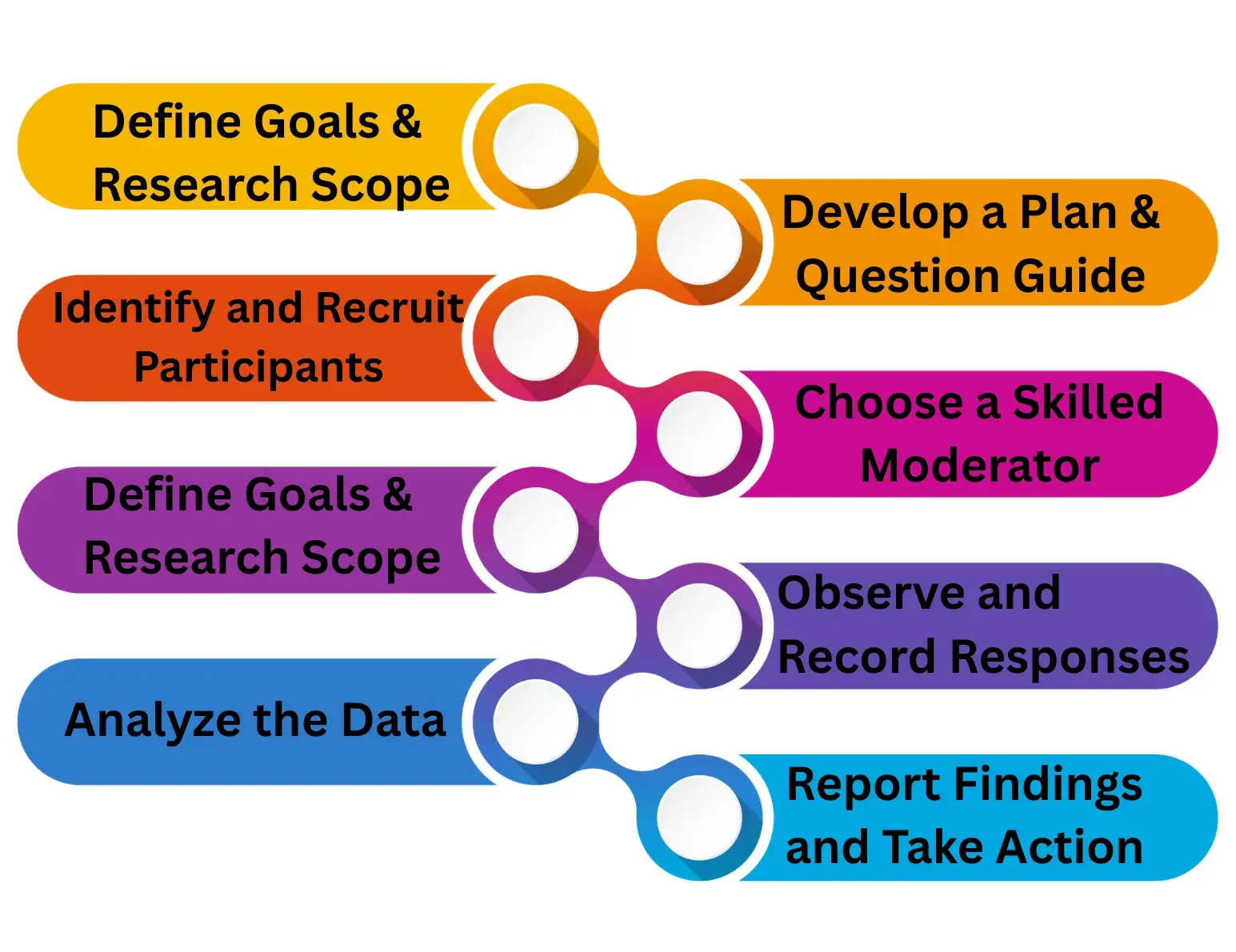
- Define Goals & Research Scope: The first and most critical step in conducting an effective focus group discussion is establishing a clear objective. Businesses must identify exactly what they want to understand, whether it is consumer attitudes, product perception, brand awareness, customer pain points, pricing reactions, or campaign effectiveness. A clearly defined purpose shapes the entire process and ensures that every question, participant, and insight remains aligned with the research goals. Without a focused scope, discussions can become too broad or irrelevant, reducing the quality of findings. A strong objective also helps determine whether the session should explore behavioral patterns, emotional triggers, unmet needs, or strategic opportunities.
- Develop a Plan & Question Guide: Create a clear plan outlining the objectives and key topics to be covered during the discussion. Questions should be arranged in a logical flow, usually beginning with broader, easy-to-answer topics before gradually moving into deeper or more sensitive discussions. This approach helps participants feel comfortable while ensuring the conversation remains natural and insightful. Flexibility is also important, allowing moderators to explore unexpected but valuable directions that may emerge.
- Identify and Recruit Participants: Participants should be carefully chosen to reflect the target audience relevant to the research objective, based on demographics, psychographics, behavior, or product usage patterns. For example, a discussion about premium skincare should involve relevant users rather than a general audience. Typically, 6 to 10 participants are selected to maintain balance between diversity of opinion and manageability. Recruitment should also ensure participants are comfortable sharing openly and represent varied perspectives within the target segment. The right participant mix increases relevance, improves discussion quality, and ensures findings are actionable.
- Choose a Skilled Moderator: A trained moderator is essential for leading the discussion effectively. They guide the conversation, ask follow-up and probing questions, encourage quieter participants to contribute, and prevent dominant voices from controlling the session. Skilled moderators know how to remain neutral, avoiding influence over responses while still steering conversations productively. Their ability to read group dynamics, interpret emotional cues, and dig deeper into responses often determines the richness and reliability of the insights collected.
- Conduct the session: The discussion itself should take place in a comfortable, distraction-free, and controlled setting that encourages open interaction. This may be a physical discussion room, research facility, or virtual platform, depending on the audience and scope. Participants should feel psychologically safe and confident that their opinions are valued. The goal is not just to collect individual responses, but to observe how ideas evolve through group interaction, disagreement, agreement, and shared experiences. A successful session balances structure with spontaneity.
- Observe and Record Responses: It is essential to capture both verbal and non-verbal responses. While spoken answers provide direct insights, body language, facial expressions, pauses, tone, and emotional reactions often reveal deeper truths. For example, hesitation or discomfort may signal concerns participants are reluctant to express directly. Sessions are usually recorded through audio or video to ensure no critical insight is missed and to support accurate post-session analysis. Researchers or observers may also take notes on group dynamics and emotional intensity. This layered observation process helps businesses uncover more authentic and nuanced consumer perspectives.
- Analyze the Data: Raw conversations must be carefully reviewed and transformed into meaningful insights. This involves examining transcripts, recordings, and observational notes to identify recurring themes, patterns, emotional triggers, consumer language, contradictions, and unexpected findings. Analysis should go beyond summarizing responses and instead focus on understanding deeper motivations, attitudes, and decision drivers. Researchers often categorize findings into key themes such as preferences, barriers, aspirations, or unmet needs. This stage is where qualitative feedback becomes strategic intelligence, allowing businesses to identify both opportunities and risks more effectively.
- Report Findings and Take Action: The final step is converting insights into clear, structured, and actionable recommendations. Findings should be summarized in a way that highlights key themes, strategic implications, and business relevance. Rather than simply presenting what participants said, the report should explain what it means for product development, branding, communication, customer experience, or market strategy. Strong reporting translates consumer voices into decision-making tools. Businesses can then use these findings to refine products, improve campaigns, adjust messaging, or strengthen customer engagement strategies. The true value of a focus group discussion lies not just in gathering insights, but in applying them effectively to drive smarter business outcomes.
FGD in India: Understanding Regional Insights
An FGD in India captures the remarkable diversity of consumer behavior across regions, communities, and socio-cultural contexts. India is far from a uniform market, each geography differs in language, traditions, income patterns, lifestyle aspirations, media exposure, and buying habits. What appeals to consumers in a metro city may not resonate in a Tier-2 town, and preferences in one state may differ significantly from another due to cultural values, social norms, and local realities. Focus group discussions help businesses move beyond broad demographic assumptions by uncovering these regional distinctions in a far more detailed and human-centered way than large-scale quantitative data alone can provide.
For example, in certain regions, purchasing decisions may be deeply influenced by family structures, community recommendations, or traditional beliefs, while in others, modern lifestyle trends, digital exposure, and peer validation may play a stronger role. In some markets, affordability and practicality may dominate consumer priorities, whereas in others, brand aspiration, status, or convenience may be more influential. An FGD in India helps reveal these subtle yet critical differences by exploring not just what consumers choose, but why they choose it, how their opinions are shaped, and what external factors influence their final decisions.
By leveraging these nuanced insights, businesses can develop products, messaging, and market strategies that are better aligned with local consumer expectations. This allows brands to customize communication, positioning, pricing, and even product features to suit specific audiences more effectively. As a result, companies can avoid the risks of one-size-fits-all strategies, improve market relevance, strengthen customer connections, and create experiences that feel more authentic and impactful across India’s highly varied consumer landscape.
Conclusion
In a market as diverse and dynamic, data alone is often not enough to fully understand consumer behavior. While quantitative research can reveal trends and patterns, focus group discussions in India provide the depth, context, and human perspective needed to uncover why consumers think, feel, and act the way they do. By enabling authentic conversations and capturing real opinions, FGDs help businesses move beyond surface-level insights to understand motivations, emotional triggers, and regional nuances more effectively.
This deeper understanding allows companies to design better products, refine strategies, test ideas more effectively, and build stronger customer relationships. In a country where culture, language, and local realities significantly shape decisions, focus group discussions offer businesses a strategic advantage by transforming consumer voices into actionable insights. For organizations aiming for sustainable growth in India, understanding the story behind the data is not just valuable, it is essential.