
Introduction
Launching a product without understanding how consumers will respond is one of the biggest risks businesses face today. A product may appear promising internally, perform well during development, and align with management expectations, but actual market success depends on how real consumers experience and evaluate it. Even strong product ideas can struggle if they fail to meet customer expectations related to usability, convenience, pricing, or overall experience.
This is why product testing has become a critical part of modern business strategy. Businesses increasingly recognize that assumptions cannot replace consumer validation. Before investing heavily in production, distribution, advertising, or expansion, companies need evidence-based insights into how products perform in real-world conditions. Product evaluation studies help businesses identify weaknesses early, improve product-market fit, and make more informed decisions before large-scale launch.
Across industries such as FMCG, food and beverages, healthcare, consumer electronics, automotive, beauty, and retail, businesses use it to improve products, reduce launch risk, and strengthen customer experience. As competition continues increasing and consumer expectations evolve rapidly, businesses increasingly rely on structured consumer feedback and research to improve product performance and long-term market success.
What is Product Testing?
This is a structured research process used to evaluate how consumers interact with and respond to a product under controlled or natural usage conditions. The objective is not simply to determine whether consumers like a product. Instead, it helps businesses understand whether the product delivers the expected consumer experience across multiple dimensions. Businesses today cannot rely only on internal opinions or technical performance because actual market success depends heavily on how consumers perceive, use, and experience the product in real-life situations.
A professional study may assess usability, packaging appeal, design effectiveness, taste, feature relevance, convenience, purchase intent, pricing perception, and overall satisfaction. It helps businesses identify both strengths and weaknesses before large-scale market launch. In many cases, even small improvements in product formulation, packaging, convenience, or usability can significantly improve customer satisfaction and repeat purchase behavior. Product evaluation studies also help businesses understand how products compare against competing alternatives in the market.
Instead of depending only on internal assumptions, it allows businesses to gather direct consumer feedback based on actual interaction and experience. This helps organizations make more informed product decisions, reduce launch risk, improve product-market fit, and strengthen customer experience before investing heavily in manufacturing, distribution, and marketing activities.
Types of Product Testing Methods
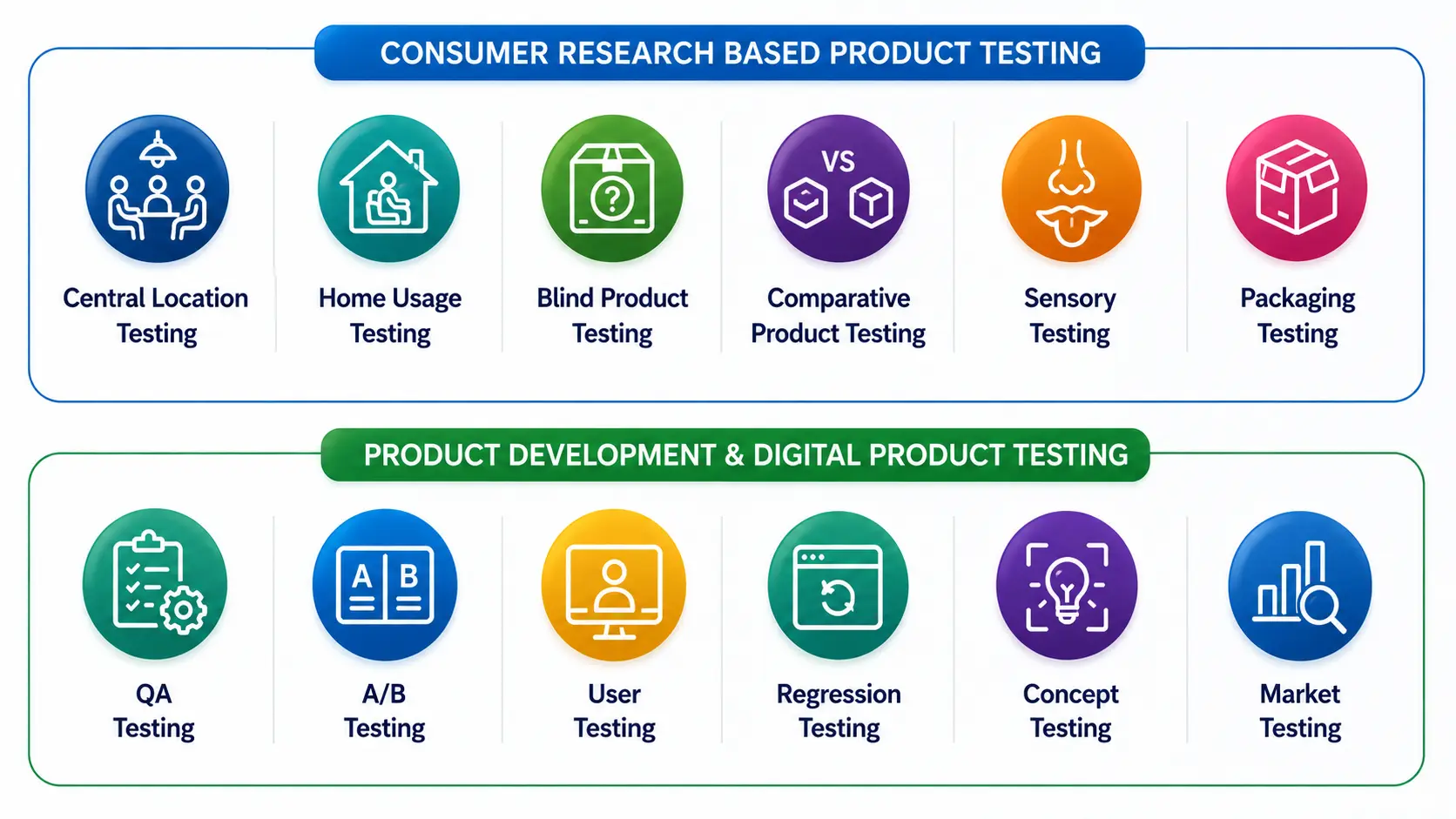
Businesses use different types of testing depending on the product category, development stage, customer interaction level, and research objectives. Some methodologies focus more on consumer behavior and market perception, while others focus on functionality, usability, and product performance.
Consumer Research Based
- Central Location Testing: Central location testing involves inviting respondents to a controlled research venue where they evaluate products under supervised conditions. This method helps maintain consistency in product exposure and testing environments, making it highly useful for food, beverage, sensory, and comparative product studies.
- Home Usage Testing: Home usage testing allows consumers to use products in their natural environment over a specified period. This methodology helps businesses understand long-term usability, convenience, satisfaction levels, and real-world product performance.
- Blind Product Testing: Blind product testing removes brand identifiers so consumers evaluate products purely based on experience and performance. This helps businesses understand unbiased consumer preference without the influence of branding or packaging perception.
- Comparative Product Testing: Comparative product testing evaluates multiple products simultaneously to understand consumer preference and competitive positioning. This method helps businesses identify strengths, weaknesses, and differentiation opportunities against competing products.
- Sensory Testing: Sensory testing evaluates consumer reactions to attributes such as taste, smell, texture, appearance, and overall sensory experience. It is commonly used in food, beverage, cosmetic, and personal care categories where sensory appeal strongly influences product acceptance.
- Packaging Testing: Packaging testing assesses consumer response toward packaging design, usability, readability, convenience, and shelf appeal. This helps businesses understand whether packaging aligns with customer expectations and supports stronger purchase intent.
Product Development & Digital
- QA Testing: Quality assurance testing focuses on evaluating whether a product functions as intended before public release. It helps businesses identify technical flaws, operational issues, and functionality gaps during the development stage.
- A/B Testing: A/B testing compares two versions of a product, feature, interface, or design element to determine which performs better. Businesses use this methodology to make data-driven decisions based on user preference and engagement behavior.
- User Testing: User testing evaluates how real users interact with a product, platform, or interface. This methodology helps businesses identify usability challenges, operational confusion, and overall customer experience gaps from the end-user perspective.
- Regression Testing: Regression testing is conducted after updates or modifications to ensure that new changes do not negatively affect existing functionality. This helps businesses maintain product stability and consistent user experience after improvements or feature additions.
- Concept Testing: Concept testing evaluates consumer response toward a product idea, concept, or innovation direction before full-scale development. This methodology helps businesses assess market interest, relevance, and potential acceptance before major investment.
- Market Testing: Market testing introduces a product to a limited market segment before large-scale launch. It helps businesses understand customer response, identify operational issues, evaluate product acceptance, and improve go-to-market strategies before wider rollout.
Why Businesses Prefer Central Location Testing
Central location testing remains one of the most preferred methodologies in professional product testing because it allows businesses to maintain stronger research control, consistency, and standardized evaluation conditions across all respondents. This methodology is widely used in categories where small environmental variations can significantly influence consumer perception and product evaluation outcomes.
Businesses prefer this testing because it creates controlled testing environments and reduces external factors that may affect consumer response. Researchers can directly monitor respondent behavior and ensure that every participant evaluates the product under similar conditions. This becomes especially important in categories such as food and beverages, where factors like serving temperature, presentation style, sequencing, lighting, or portion size can influence perception. Central location testing also improves comparison accuracy, observation quality, and speed of insight generation.
Key Benefits of Product Testing
Product testing provides businesses with several important advantages before large-scale market launch. It helps companies reduce uncertainty, improve customer experience, and make more informed product decisions based on real consumer feedback rather than assumptions.
- Reducing Product Launch Risk: It helps businesses identify potential issues before market launch. This reduces the chances of product rejection, poor customer response, or expensive relaunch costs after commercialization.
- Improving Customer Satisfaction: By understanding how consumers interact with products, businesses can improve usability, convenience, functionality, and overall experience, leading to stronger customer satisfaction.
- Identifying Product Weaknesses Early: This testing helps uncover hidden issues related to design, packaging, functionality, taste, durability, or performance before products reach the broader market.
- Understanding Consumer Preferences: Businesses gain direct insight into what consumers value most, including features, design elements, convenience factors, and emotional triggers influencing purchase decisions.
- Improving Product-Market Fit: This also helps brands understand whether products align with actual consumer expectations, market demand, and category requirements across target audiences.
- Benchmarking Competitors: Comparative testing allows businesses to evaluate how their products perform against competing alternatives and identify opportunities for differentiation.
- Strengthening Brand Positioning: Consumer feedback gathered through it helps businesses refine product communication, positioning strategies, and perceived value in the market.
- Increasing Repeat Purchase Potential: Products that perform well during testing are more likely to generate repeat usage, customer loyalty, and stronger long-term market acceptance.
- Supporting Innovation Decisions: Businesses use these testing insights to validate new concepts, improve innovation strategies, and prioritize features or improvements more effectively.
- Improving Pricing and Packaging Strategies: It also helps businesses understand how consumers perceive pricing, packaging design, visual appeal, and value proposition before launch.
Challenges in Product Testing
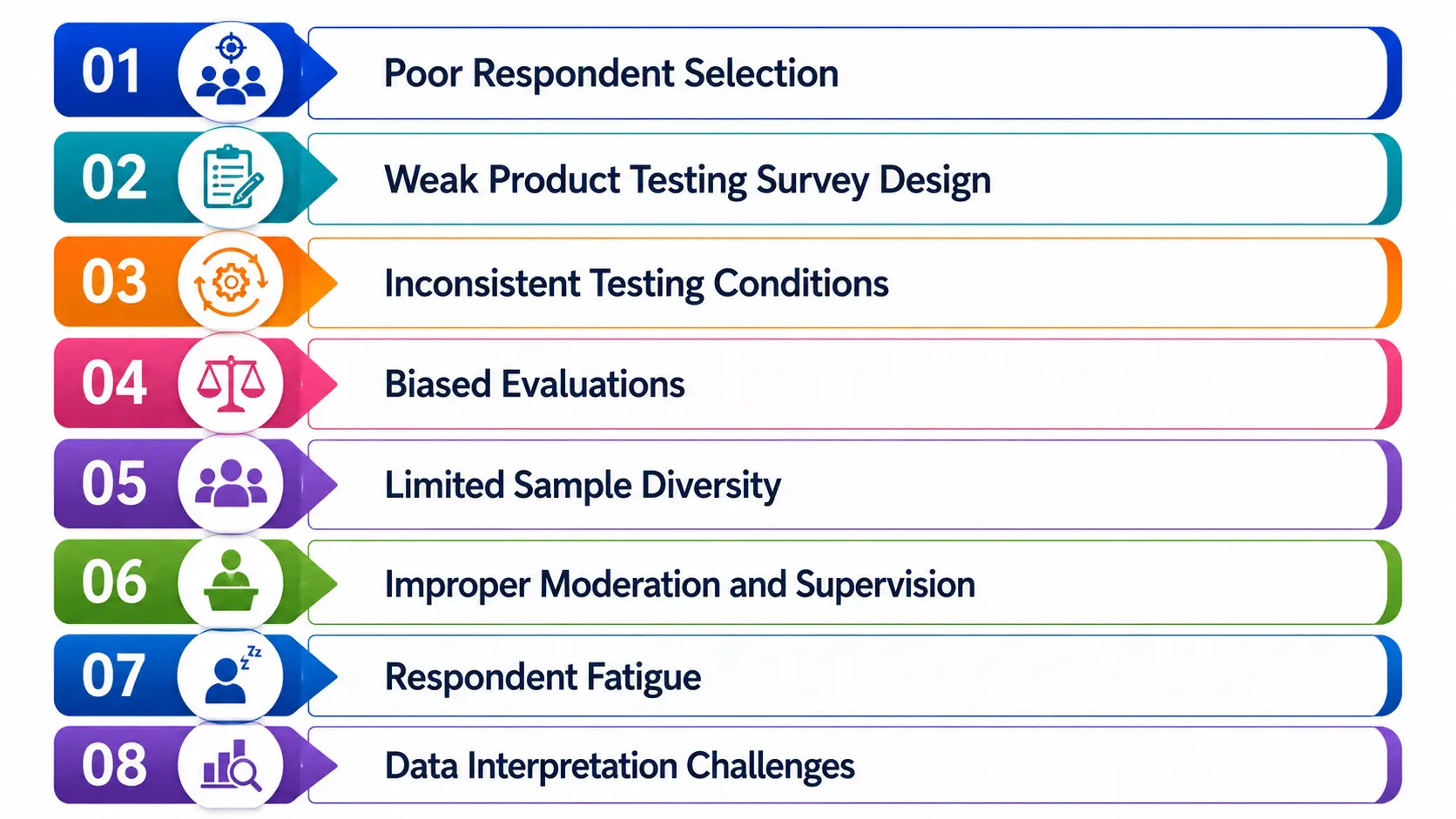
Poor execution can significantly affect the accuracy and usefulness of findings. Challenges which may occur during the testing:
- Poor Respondent Selection: If respondents do not properly represent the target audience, the findings may not accurately reflect actual market behavior or customer expectations.
- Weak Product Testing Survey Design: Poorly structured questionnaires, leading questions, or unclear evaluation scales can create biased responses and unreliable findings.
- Inconsistent Testing Conditions: Variations in environment, product exposure, serving conditions, or evaluation methods can influence consumer perception and reduce comparison reliability.
- Biased Evaluations: Respondents may sometimes be influenced by branding, presentation style, moderator behavior, or prior perceptions, affecting the objectivity of the results.
- Limited Sample Diversity: A narrow or unbalanced respondent sample may fail to capture differences across demographics, regions, income groups, or lifestyle segments.
- Improper Moderation and Supervision: Weak moderation during location testing or product interaction sessions can affect observation quality and reduce the consistency of evaluations.
- Respondent Fatigue: Long evaluation sessions or excessive questioning may reduce respondent attentiveness, affecting the accuracy and quality of feedback.
- Data Interpretation Challenges: Even well-executed product testing studies require careful analysis. Misinterpreting consumer feedback can lead to flawed business decisions and incorrect product improvements.
Product Testing Process
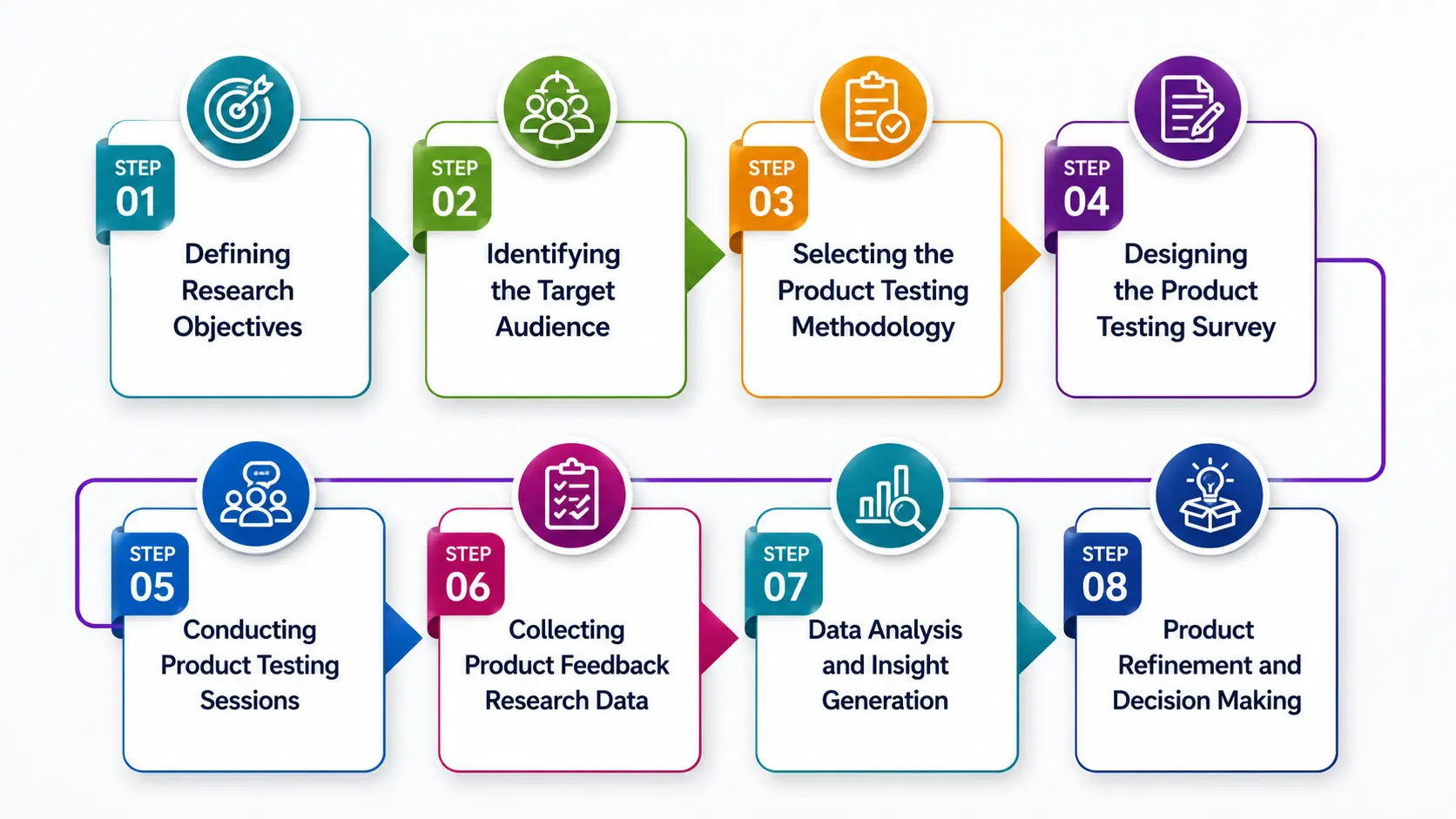
A professional product testing process follows a structured and systematic approach designed to assess a product accurately under controlled or real-world usage conditions.
- Defining Research Objectives: The process begins with understanding the primary objectives behind the study. Different businesses conduct testing for different reasons depending on the category, product stage, and business goals. Clearly defining the objectives is important because it determines the testing methodology, respondent profile, evaluation parameters, and reporting structure.
- Identifying the Target Audience: This next step involves identifying the right consumer group for the study. Respondent selection is extremely important because the quality of insights depends heavily on whether the participants accurately represent the intended target market. Businesses may define respondents based on factors such as age, gender, location, income group, lifestyle, category usage behavior, or purchase frequency. Proper audience selection helps ensure that the findings reflect actual consumer expectations and market realities.
- Selecting the Product Testing Methodology: The appropriate product testing methodology is then selected based on the product category and research requirements. Businesses may choose methodologies such as central location testing, home usage testing, blind product testing, or comparative product testing depending on the nature of the evaluation.For example, central location testing is commonly used for food, beverages, and sensory studies where standardized testing conditions are important. Home usage testing is often preferred for products that require long-term interaction under natural usage conditions.
- Designing the Product Testing Survey: A structured product testing survey is then developed to capture detailed consumer feedback during the evaluation process. The survey generally includes questions related to usability, packaging appeal, design, taste, convenience, feature relevance, satisfaction levels, purchase intent, and overall product perception. Poorly structured questionnaires can create biased responses and unreliable findings. The survey must maintain logical flow, neutral wording, and appropriate evaluation scales.
- Conducting Product Testing Sessions: Once the preparation stage is completed, product testing sessions are conducted with selected respondents. Depending on the methodology, respondents may evaluate products in controlled environments through central location testing or use products in natural environments during home usage testing.
The goal is to capture authentic consumer reactions and usage experiences under realistic conditions. During the evaluation process, researchers may also observe behavioral responses, interaction patterns, emotional reactions, and comparative preferences.
- Collecting Product Feedback Research Data: After product interaction is completed, detailed product feedback research data is collected from respondents. This stage focuses on understanding consumer likes and dislikes, product strengths and weaknesses, usage barriers, satisfaction levels, purchase intent, comparative preferences, and improvement suggestions.
- Data Analysis and Insight Generation: The collected responses are then analyzed to identify meaningful consumer insights and patterns. The analysis may include consumer preference trends, segment-wise behavior differences, comparative performance analysis, satisfaction drivers, and improvement opportunities. Businesses use these insights to refine products, improve packaging, optimize pricing strategies, strengthen positioning, and improve overall market readiness.
- Product Refinement and Decision Making: The final stage involves using the findings to make informed product decisions. Businesses may decide to modify product features, improve packaging, adjust pricing, refine communication strategies, improve usability, reposition the product, proceed with launch, and conduct additional testing if required.
This stage ensures that product decisions are supported by real consumer evidence rather than assumptions or internal opinions. A structured testing process helps businesses reduce launch risk, improve customer satisfaction, and build products that align more effectively with market expectations.
The Future of Product Testing
The future of product testing survey is expected to become increasingly consumer-centric, technology-enabled, and behavior-driven.
Businesses today understand that successful products depend not only on functionality but also on usability, emotional connection, convenience, and overall customer experience. Future product testing survey are likely to include AI-assisted product feedback analysis, advanced sensory testing, virtual product simulations, omnichannel evaluations, and faster iterative testing cycles.
As consumer expectations continue evolving rapidly, businesses will increasingly rely on continuous testing and product feedback research to maintain competitiveness and improve innovation effectiveness.
Product Feedback Research and Consumer Understanding
Product feedback research plays a major role in helping businesses improve products and customer experience. The objective of product feedback research is not simply to identify whether consumers like or dislike a product.
The real value lies in understanding why consumers respond a certain way.
This research helps businesses understand emotional reactions, usage barriers, frustration points, unmet expectations, feature priorities, and purchase motivations. It often reveals hidden insights that internal product development teams may overlook.
Consumers evaluate products very differently from businesses. Real-world usage frequently exposes problems or opportunities that are difficult to identify internally. This makes product feedback research extremely valuable for product optimization and innovation strategy.
Conclusion
Successful products are built around real consumer needs, expectations, and experiences. This is why businesses increasingly rely on structured consumer research before launching products into competitive markets. Understanding how people respond to a product helps organizations make better decisions, improve customer experience, and reduce uncertainty before large-scale investment. It also helps businesses identify hidden product gaps, usability concerns, and improvement opportunities before products reach a wider customer base.
As markets become more competitive and consumer expectations continue evolving, businesses that continuously evaluate and refine their products will be far better positioned for long-term success. Research-driven product evaluation not only helps improve market readiness but also supports stronger customer satisfaction, repeat usage, and better brand trust over time. Businesses that actively use consumer feedback are often better equipped to improve innovation strategies, strengthen product positioning, and maintain competitiveness in rapidly changing markets.