
Introduction
Customer experience has become one of the biggest competitive differentiators for businesses today. Products can be copied. Pricing can be matched. Marketing campaigns can be replicated. But customer experience is far more difficult to duplicate consistently across locations, teams, and touchpoints. This is exactly why mystery shopping services have become one of the most powerful tools for brands looking to improve operational consistency, customer satisfaction, and frontline performance.
In a market as dynamic and diverse as India, where customer expectations continue to evolve rapidly, relying only on internal reports or customer complaints is no longer enough. Businesses need structured, unbiased, and real-world insights into how customers are actually being treated. This is where professional mystery shopping services play a critical role.
What are Mystery Shopping Services?
Mystery shopping services are a research and evaluation method where trained individuals, known as “mystery shoppers,” visit a business location or interact with a brand as regular customers. Their role is to objectively assess the customer experience based on predefined parameters.
The goal of mystery shopping services is not simply to identify mistakes but also to understand whether the customer experience aligns with the brand’s promised standards and whether operational execution is consistent across customer touchpoints.
This study can evaluate service quality, employee behavior, product knowledge, upselling practices, complaint handling, SOP compliance, store presentation, waiting time, responsiveness, and overall customer engagement. Businesses can also assess whether customer interactions align with brand positioning and service expectations.
Over the years, mystery shopping services have evolved from a simple compliance-checking activity into a broader customer experience intelligence framework. Businesses no longer use this only to identify operational gaps. They use it to improve customer retention, strengthen loyalty, benchmark competitors, and create more consistent experiences across locations.
Why Mystery Shopping Services Matter More Than Ever
- Rising Customer Expectations: Customer expectations today are significantly higher than they were even a few years ago. Customers no longer evaluate brands only on product quality or pricing. They increasingly judge businesses based on the overall experience delivered across every touchpoint. Customers today expect the following: faster service, personalized interactions, consistent experiences, knowledgeable staff, smooth omnichannel support, and better issue resolution. Businesses that fail to meet these expectations often struggle with customer retention and long-term loyalty.
- Increasing Market Competition: Competition across industries has intensified rapidly. Customers now have multiple alternatives available at their fingertips, making switching between brands easier than ever before. A single poor customer interaction at a store, branch, dealership, restaurant, or service center can immediately push customers toward competitors. This has made customer experience one of the strongest competitive differentiators in modern business environments.
- Limitations of Traditional Feedback Systems: Businesses can no longer rely only on customer complaints, feedback forms, or internal reporting systems to understand service quality. Most dissatisfied customers never formally complain. Instead, many quietly stop purchasing from the brand altogether. Similarly, internal evaluations may not accurately reflect real customer experiences because employee behavior often changes during announced inspections or reviews. This creates a major visibility gap between perceived service quality and actual customer experience.
Different types of Mystery Shopping
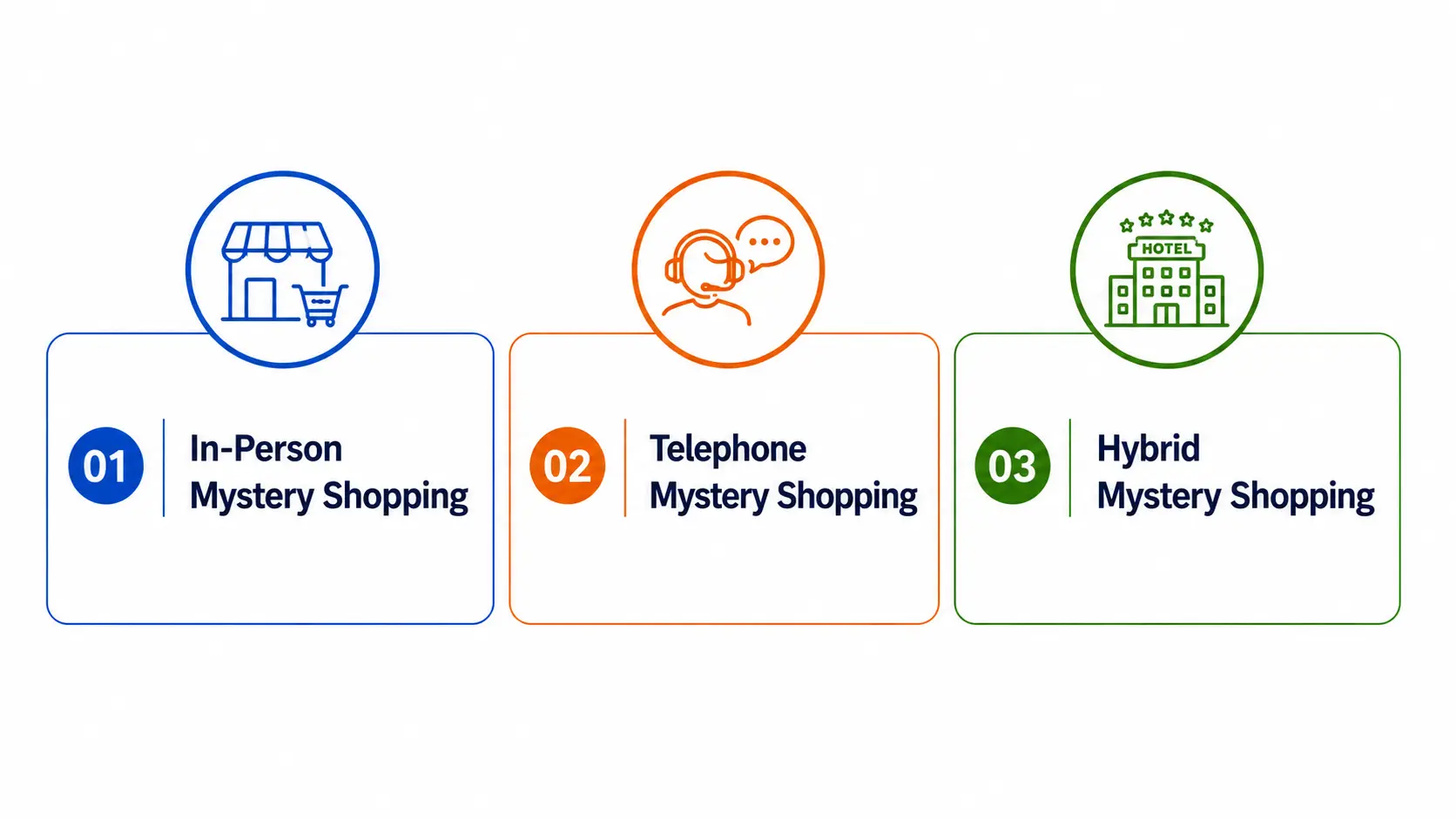
Mystery Shopping Services can be conducted in person, over the telephone, or online. In each of these cases, mystery shoppers are looking to gather information about customer service and the customer experience.
- In-Person secret shopping: These are common in industries such as retail and restaurants. Such shoppers visit a business and interact with employees as if they were customers. This type is often used to measure how well employees provide service and how well the business is performing from a customer’s perspective.
- Telephone mystery shopping: These are for call center environments and industries where the telephone is an integral part of the customer experience. For example, a telecommunications company might use this method to measure how efficiently its call center agents handle calls from customers.
- Hybrid mystery shopping: This type of shopping involves mystery shoppers following an entire customer journey. This type of method is popular because it delivers a world-class customer experience. For example, a hotel might use hybrid mystery shopping to measure all aspects of the customer experience, from check-in to checkout.
They can be found in different industries. Many companies use the hybrid method because it allows them to assess all aspects of their customer experience quickly and easily. Mystery shoppers can use a variety of methods to gather information, such as face-to-face interviews and surveys. This gives companies a comprehensive view of how well they are delivering on their customer experience promises.
The Growing Demand for Mystery Shopping Services In India
The demand for mystery shopping services in India has increased significantly in recent years as businesses place greater focus on customer experience management and service consistency. Several factors are driving this growth:
- Expansion of Organized Retail and Franchise Networks: Businesses operating across multiple cities and locations increasingly require standardized customer experiences across all outlets, branches, and franchise units.
- Rise of Experience-Driven Consumers: Indian consumers today are more aware, digitally connected, and experience-focused than ever before.
- Changing Customer Evaluation Criteria: Customers now compare brands not only on pricing or product quality but also on convenience, responsiveness, staff behavior, service efficiency, and overall customer experience.
- Growing Adoption Across Industries: These programs are increasingly being used across the retail, hospitality, banking, automotive, telecom, healthcare, and real estate sectors.
- Regional and Market Diversity in India: Customer expectations vary significantly across regions, languages, cultures, and city tiers, making customer experience management more complex.
- Need for Location-Specific Insights: A service model that works effectively in one city or market may not necessarily perform similarly in another. It helps businesses understand these local operational realities.
- Importance of Brand Consistency: These programs help organizations maintain broader brand consistency while adapting to local customer expectations and market behavior.
- Shift Toward Continuous Monitoring: Many businesses now conduct continuous mystery shopping assessments instead of one-time studies because customer experience changes constantly due to staff turnover, operational pressure, seasonal demand fluctuations, management changes, and training quality differences.
- Increasing Focus on Long-Term Customer Experience Management: Businesses increasingly recognize that customer experience monitoring must be ongoing to maintain service quality, customer loyalty, and competitive differentiation.
How Mystery Shopping Works
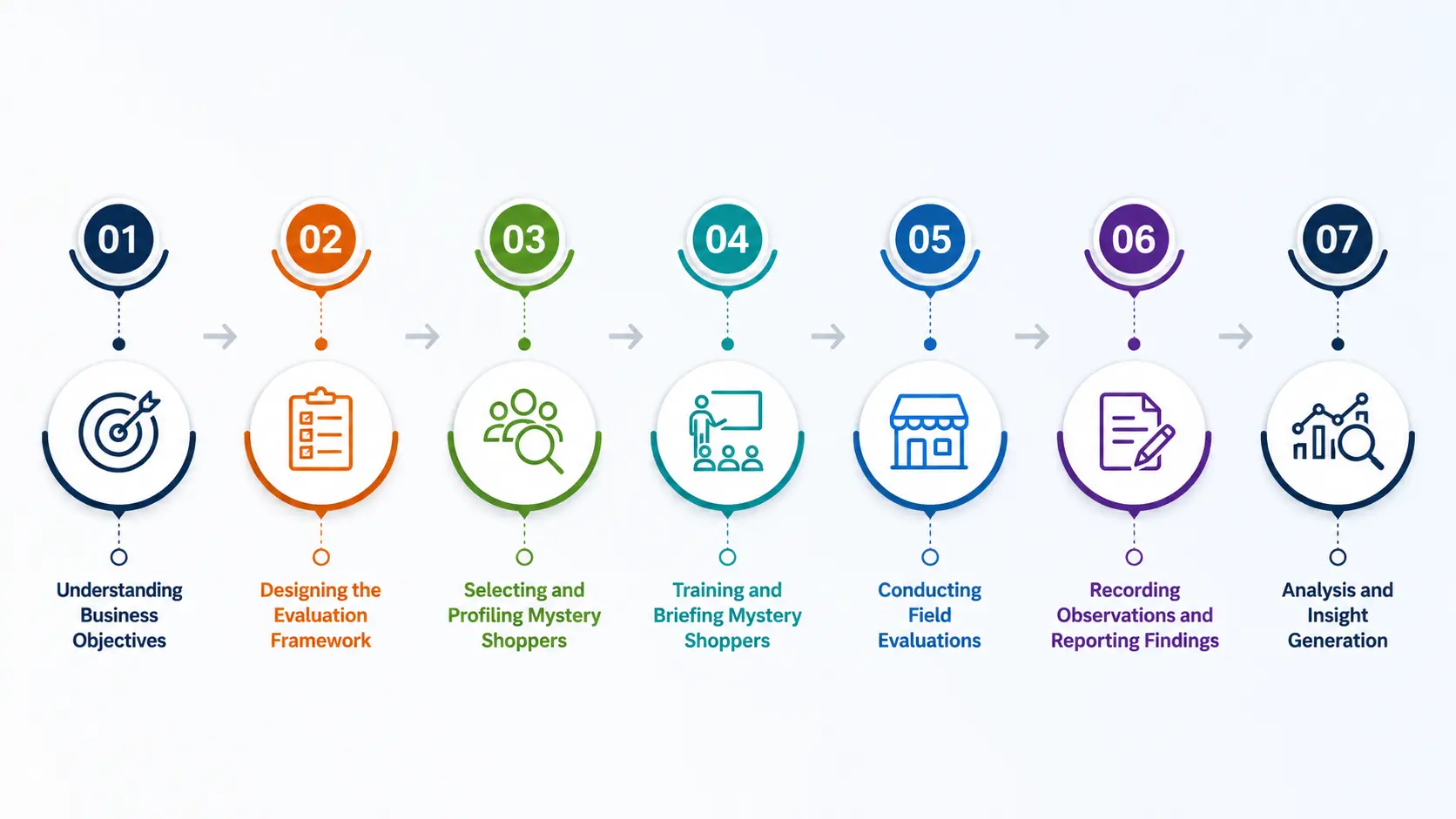
A professional mystery shopping process follows a structured methodology designed to ensure consistency, objectivity, and actionable insight generation. Each stage of the process helps businesses accurately evaluate customer experience, operational performance, and frontline execution.
- Understanding Business Objectives: The process begins with identifying the core objectives of this study. Different organizations use mystery shopping for different business requirements, such as evaluating service quality, assessing staff professionalism, monitoring SOP compliance, measuring sales effectiveness, benchmarking competitors, or understanding customer handling practices. Clearly defining the objectives is important because it determines the structure of the evaluation framework, reporting format, and analysis approach.
- Designing the Evaluation Framework: Once the objectives are finalized, a structured evaluation framework is developed to standardize the audit process. This framework generally includes scoring parameters, customer journey checkpoints, interaction scenarios, observation guidelines, compliance indicators, and behavioral assessment criteria. A strong framework ensures that evaluations remain consistent across all locations, shoppers, and customer interactions.
- Selecting and Profiling Mystery Shoppers: The next step involves selecting suitable mystery shoppers who closely resemble the target customer profile of the brand. Shopper profiling is important because the evaluator should naturally fit the customer category being assessed. For example, luxury retail studies may require premium-profile shoppers, while banking studies may require financially aware participants. Proper shopper selection improves both the authenticity and reliability of the evaluation process.
- Training and Briefing Mystery Shoppers: Before field execution begins, mystery shoppers undergo detailed training and briefing sessions. They are trained on study objectives, observation techniques, reporting standards, customer interaction scenarios, and evaluation protocols. This stage is critical because consistency in shopper understanding helps reduce reporting bias and improves the reliability of observations across the study.
- Conducting Field Evaluations: Once training is completed, mystery shoppers conduct interactions as regular customers without revealing their identity or purpose. Depending on the project scope, these evaluations may include in-store visits, telephone inquiries, website interactions, app-based assessments, delivery evaluations, service center visits, or customer support interactions. The objective is to capture genuine customer experiences under real operating conditions.
- Recording Observations and Reporting Findings: After completing the interaction, these shoppers submit structured reports documenting their observations and experience assessments. These reports generally evaluate service quality, employee behavior, product knowledge, SOP compliance, responsiveness, customer handling effectiveness, and overall experience consistency. Detailed reporting ensures that businesses receive measurable and evidence-based operational insights rather than subjective opinions.
- Analysis and Insight Generation: Professional service providers then analyze the collected observations to generate actionable business insights. This analysis may include performance scorecards, location-wise comparisons, customer journey insights, operational gap identification, benchmarking analysis, and improvement recommendations.
These findings help businesses improve frontline execution, strengthen customer experience consistency, identify operational weaknesses, and make more informed operational decisions.
Mystery Shopping Audit vs Traditional Audit
While both mystery shopping audits and traditional operational audits are important for business performance evaluation, they serve very different purposes.
The table below highlights the key differences between the two approaches:
| Parameter | Traditional Audit | Mystery Shopping Audit |
|---|---|---|
| Primary Focus | Operational processes and compliance | Customer experience and service execution |
| Objective | Ensure systems, procedures, and documentation are followed correctly | Evaluate how customers are actually treated during interactions |
| Evaluation Perspective | Internal operational perspective | External customer perspective |
| Key Assessment Areas | Documentation, inventory, financial controls, SOP adherence, regulatory compliance | Staff behavior, communication, responsiveness, service quality, customer handling |
| Nature of Evaluation | Structured operational inspection | Real-world customer interaction assessment |
| Employee Awareness | Employees are usually aware of the audit | Employees are generally unaware they are being evaluated |
| Measurement Focus | Process efficiency and compliance accuracy | Customer satisfaction and experience quality |
| Example in Retail | Verifying inventory accuracy and billing compliance | Assessing staff friendliness, greeting behavior, and product recommendation quality |
| Example in Hospitality | Checking hygiene standards and operational compliance | Evaluating guest experience and service responsiveness |
| Outcome | Identifies operational and compliance gaps | Identifies customer experience and service delivery gaps |
| Reporting Style | Compliance reports and operational findings | Customer journey insights, scorecards, and behavioral observations |
| Business Impact | Improves operational control and process efficiency | Improves customer satisfaction, loyalty, and service consistency |
Key Benefits of Mystery Shopping
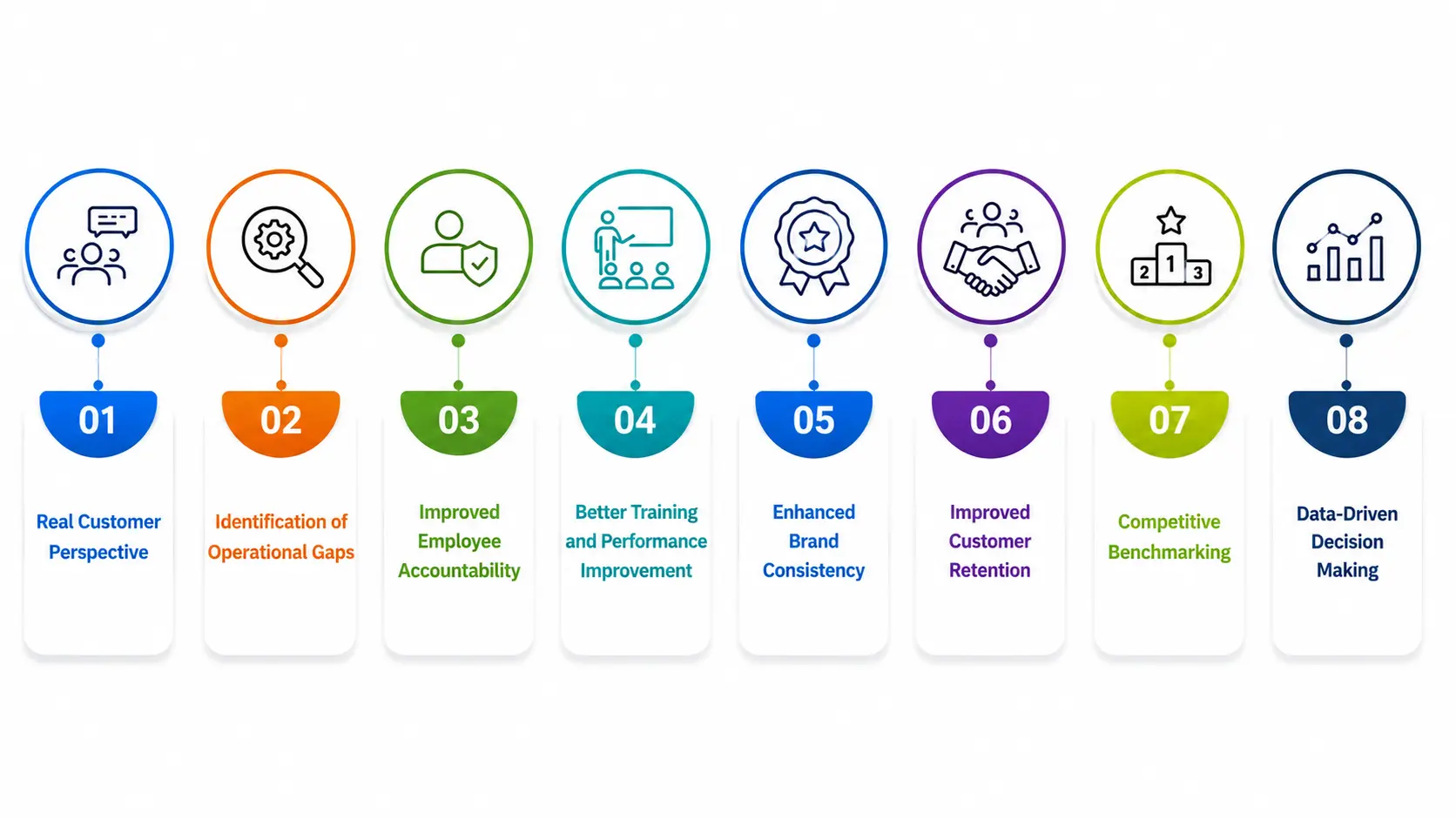
This method provides businesses with structured and real-world insights into how customers actually experience their brand. Beyond identifying operational gaps, it helps organizations improve customer satisfaction, service consistency, employee performance, and overall business effectiveness. Some of the key benefits of mystery shopping include:
- Real Customer Perspective: It provides businesses with an unbiased external perspective on customer interactions. It helps organizations understand how customers actually experience their services rather than relying only on internal assumptions.
- Identification of Operational Gaps: It helps uncover hidden operational issues that may otherwise go unnoticed, including poor customer handling, weak communication, delayed response times, or inconsistent service delivery.
- Improved Employee Accountability: When employees know customer interactions may be evaluated regularly, service consistency and professionalism often improve naturally across locations and teams.
- Better Training and Performance Improvement: Findings from mystery shopping studies help businesses identify specific training needs related to product knowledge, communication, responsiveness, upselling, and customer engagement.
- Enhanced Brand Consistency: For businesses operating across multiple branches or franchise locations, mystery shopping helps ensure that customers receive a consistent brand experience across all touchpoints.
- Improved Customer Retention: Better customer experiences often lead to higher customer satisfaction, repeat purchases, stronger loyalty, and improved long-term retention.
- Competitive Benchmarking: Businesses can use mystery shopping to evaluate competitor service quality, customer handling practices, and overall customer experience strategies.
- Data-Driven Decision Making: It also provides measurable insights and structured observations that help businesses make more informed operational and customer experience decisions.
Challenges in Mystery Shopping India
While mystery shopping offers significant advantages, execution in India comes with several operational and market-specific challenges. Large-scale mystery shopping India projects require strong field management systems, quality controls, and experienced execution capabilities to maintain consistency and reliability. Some of the key challenges include:
- Geographic Diversity: India’s large geographic spread and regional variation make field execution more complex compared to many other markets.
- Language and Cultural Variations: Customer behavior, communication styles, and service expectations vary significantly across states, cities, and local markets.
- Inconsistent Shopper Quality: Maintaining consistency in shopper observation and reporting quality can be difficult if training and quality assurance systems are weak.
- Regional Differences in Customer Expectations: Service expectations in metro cities may differ considerably from those in Tier 2 or Tier 3 markets, making standardization more challenging.
- Infrastructure and Accessibility Constraints: Remote locations, transportation limitations, and inconsistent infrastructure can sometimes affect execution timelines and monitoring efficiency.
- Maintaining Evaluation Authenticity: Poorly trained mystery shoppers may unintentionally reveal the purpose of the visit, which can affect the authenticity and accuracy of customer interactions.
- Data Consistency Challenges: Variations in shopper interpretation, reporting quality, and observation methods can impact data reliability if proper standardization mechanisms are not followed.
- Need for Strong Quality Control Systems: Large-scale mystery shopping India programs require robust supervision, validation, monitoring, and audit systems to maintain data accuracy and operational consistency.
Industries Using Mystery Shopping in India
- Retail remains one of the largest users of mystery shopping India programs. Retail brands use such methods to evaluate store presentation, staff engagement, billing efficiency, upselling behavior, product recommendations, and customer handling quality.
- Banking and financial services organizations use mystery shopping audit programs to assess branch service quality, relationship management, financial product communication, complaint handling, and onboarding efficiency.
- Hospitality brands rely heavily on mystery shopping services to evaluate guest experience, reservation handling, food quality consistency, cleanliness standards, and staff responsiveness.
- Automotive companies use mystery shopping India studies to assess dealership experience, test drive quality, product explanation, sales process adherence, and after-sales engagement.
- Healthcare organizations increasingly use mystery shopping to understand patient interaction quality, appointment management efficiency, reception handling, and transparency in communication.
- Telecom, education, real estate, and consumer electronics brands are also increasingly investing in mystery shopping as customer experience becomes a stronger competitive differentiator.
Technology and the Evolution of Mystery Shopping
Technology has transformed the way mystery shopping services studies are conducted. Modern mystery shopping services increasingly use mobile-based reporting systems, geo-tagging, timestamp verification, image uploads, audio validation, dashboard analytics, and real-time monitoring tools. These technologies significantly improve data accuracy, operational transparency, and reporting efficiency. Businesses can now monitor field progress in real time, compare location-wise performance instantly, and identify operational trends much faster than before.
Technology has also made large-scale mystery shopping India projects more operationally feasible across multiple cities and regions. In the future, artificial intelligence and advanced analytics are expected to play a much larger role in mystery shopping. Businesses are increasingly integrating customer experience data with broader operational and performance intelligence systems to generate deeper insights.
Conclusion
Customer experience is no longer just a support function. It has become a critical business growth driver. Businesses today operate in highly competitive environments where customers expect consistency, convenience, responsiveness, and quality interactions across every touchpoint.
This is why mystery shopping services have evolved into one of the most valuable tools for understanding real customer experiences and improving operational execution. Whether businesses are evaluating service quality, monitoring SOP compliance, benchmarking competitors, or improving employee performance, mystery shopping provides structured and actionable insights that traditional reporting systems often fail to capture.
As the importance of customer experience continues growing, mystery shopping services in India programs and professional mystery shopping services will become increasingly important across industries. The businesses that succeed in the future will not simply be the ones offering good products or competitive pricing. They will be the ones consistently delivering better customer experiences.
And that begins with understanding what customers truly experience when they interact with your brand.