
Introduction
In today’s business world, the IDI research method plays a critical role because relying only on numbers alone won’t explain why people make choices. Quantitative research helps us see trends but doesn’t tell us the full story. In-depth Interviews in India help companies use them to understand what people really think and what drives their decisions and to get insights that surveys can’t provide. This is especially used in places like India, where people’s behavior varies a lot depending on where they’re from and what group they belong to.
What is an In-Depth Interview?

In-depth Interviews in India are a way of doing research where you have conversations with people one-on-one. The goal is to understand their thoughts, experiences, feelings, and motivations. Unlike surveys with written questions, these conversations are more flexible. This way interviewers can ask follow-up questions based on what the person says. When businesses ask what IDI research is, the answer is simple: it’s a way to understand why people do what they do through conversations. It’s about getting a grasp of what drives people’s decisions.
Key Features of the In-Depth Interview
The depth, flexibility, and human understanding of the In-Depth Interviews in India offered to the process set it apart from other research approaches. In order to guarantee that the insights produced are significant and useful, each trait is crucial:
1. One-on-One Interaction: A direct, one-on-one discussion between the interviewer and the respondent is the foundation of the IDI approach. Respondents are more likely to share honest opinions, personal experiences, and sensitive insights in this private and comfortable space. Unlike group settings, there is no peer influence, judgment, or pressure to conform. The one-on-one setup allows the interviewer to fully focus on the individual, observe subtle cues such as tone, hesitation, or emphasis, and tailor the conversation based on responses.
2. Open-Ended Structure: Rigid questionnaires with fixed answer options are not considered the basis of the IDI approach. It makes use of an adaptive conversation guide instead. Rather than being a script, this guide serves as a route map. It guarantees that important subjects are addressed while letting the discussion flow organically. This framework is particularly helpful when investigating new markets, comprehending new patterns, or researching intricate consumer behavior. Open-ended questions encourage respondents to express their thoughts freely, provide detailed explanations, share stories and experiences, and reveal insights that may not have been anticipated.
3. Probing and Exploration: One of the strongest aspects of the IDI research method is the ability to dive deep into the conversation. Interviewers are trained to ask follow-up questions based on responses. Instead of getting surface-level answers, they explore further to understand the reason behind them. For example, if a respondent says they prefer a product, the interviewer may ask why; if they express dissatisfaction, the interviewer explores the root cause; if they mention a habit, the interviewer uncovers the context behind it. This process helps uncover hidden motivations, emotional drivers, and decision-making triggers.
4. Contextual Understanding: The IDI research method goes beyond collecting opinions. It focuses on understanding the context in which those opinions are formed. Consumer decisions are rarely isolated. They are influenced by daily routines, cultural environment, social interactions, economic conditions, and accessibility and availability.
Through detailed conversations, researchers gain a clear picture of how real-life situations shape consumer behavior. For example, a product preference may not just be about quality but about ease of access, usage, local availability, and peer influence. This understanding helps businesses make strategies that are aligned with the consumers.
5. Depth Over Scale: Unlike quantitative research, which focuses on large sample sizes, this approach prioritizes depth over volume. A smaller number of interviews is conducted, but each interview generates data that is insightful. This approach allows researchers to explore topics in detail, capture nuanced insights, identify patterns across responses, and build a comprehensive understanding of the subject.
Types of In-Depth Interviews
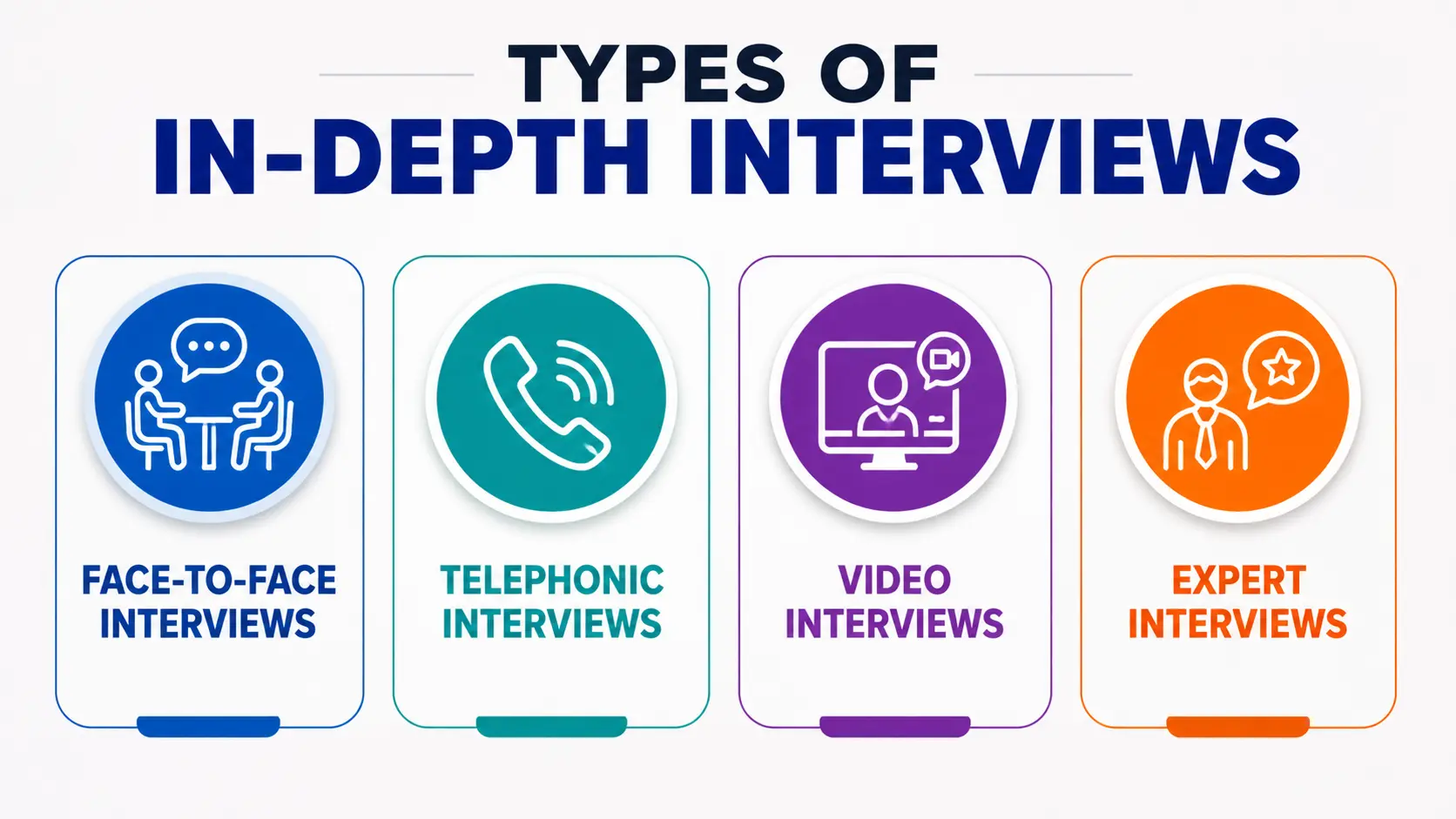
The IDI research method is highly flexible and can be adapted to different formats depending on the research objective, target audience, geography, and operational constraints. Choosing the right format is critical, as it directly impacts the quality, depth, and reliability of insights gathered. Below are the key types of IDI, along with their applications, strengths, and considerations.
1. Face-to-Face Interviews: Face-to-face interviews are the most traditional and immersive format of the IDI research method, where the interviewer meets respondents in person at their home, workplace, or another suitable location. This approach is especially effective in semi-urban and rural markets, where digital access may be limited and trust-building is essential. A key advantage is the ability to observe body language, tone, and surroundings, which often provide deeper context beyond spoken responses.
2. Telephonic Interviews: Telephonic interviews are a more efficient and cost-effective format of the IDI research method, particularly useful when speed and geographic reach are important. In this approach, conversations are conducted over the phone, which allows researchers to connect with respondents across different locations without physical presence.
This format works well for quick exploratory studies, customer feedback, and follow-up discussions. It enables faster data collection; however, it also limits as there is no visual interaction and nonverbal cues are missed. Conversations are mostly shorter, as respondents tend to have lower attention spans on calls.
3. Video Interviews: Video interviews have become increasingly popular within the IDI research method, especially for urban and digitally connected respondents. They are conducted through video conferencing platforms; this format combines the benefits of face-to-face interaction with the convenience of remote access. It allows the interviewer to observe facial expressions and reactions while eliminating the need to travel. This makes it useful for engaging with professionals, urban consumers, and B2B respondents. Technical disruptions and screen fatigue sometimes affect the flow of conversation.
4. Expert Interviews: Expert interviews are a specialized form of the IDI research method that focuses on individuals with deep industry knowledge or professional experience. Unlike consumer interviews, these discussions are more structured and strategic, which aims at understanding market dynamics, validating assumptions, and obtaining high-level perspectives. Respondents include industry professionals, consultants, policymakers, or senior decision-makers.
IDIs in India: Understanding Market Complexity
Conducting IDI research in India requires a far more nuanced approach than in many other markets because of the country’s diversity. India’s scale often creates the impression of one large consumer opportunity, but from a research and business perspective, it is far more complex. India is a collection of many micro-markets, each shaped by a different set of social, cultural, economic, and behavioral factors. So, in order to understand Indian consumers, one needs to get away from assumptions and national averages.
- Language Variations: India’s linguistic diversity shapes how consumers interpret products, services, and messaging. A concept that works in one region may not work the same way in another. Language also affects comfort during interviews, as respondents are often more open and authentic in their native language. This makes localization, moderator selection, and cultural familiarity critical while conducting these interviews.
- Cultural Diversity: The cultural diversity of India plays a crucial role in shaping consumer behavior. The family structure, traditions, social norms, and lifestyle in different parts of the country impact purchasing priorities, trust, and brand perception. For instance, one market might be more family recommendation-centric, while another might be more driven by aspiration or convenience.
- Income Differences: India’s consumer economy goes from highly affluent urban buyers to value-sensitive rural populations. Income differences influence affordability, price expectations, category access, and perceived value. A strategy that succeeds in one market may not work in another, making the IDI research method valuable for understanding how consumers across segments define relevance differently.
- Regional Preferences: Consumer behavior in India is deeply regional. Preferences for food, fashion, technology, and retail channels vary sharply across geographies. Local ecosystems shape brand loyalty, adoption speed, and communication effectiveness. In-depth interviews in India help businesses understand not just what consumers prefer, but why regional context shapes those choices.
- Urban and Rural Dynamics: One of India’s biggest market complexities lies in the difference between urban and rural consumers. Urban markets often have higher digital exposure, broader brand access, and faster lifestyle patterns, while rural markets are inclined more towards local trust, community validation, accessibility, and practicality.
Process of In-Depth Interviews
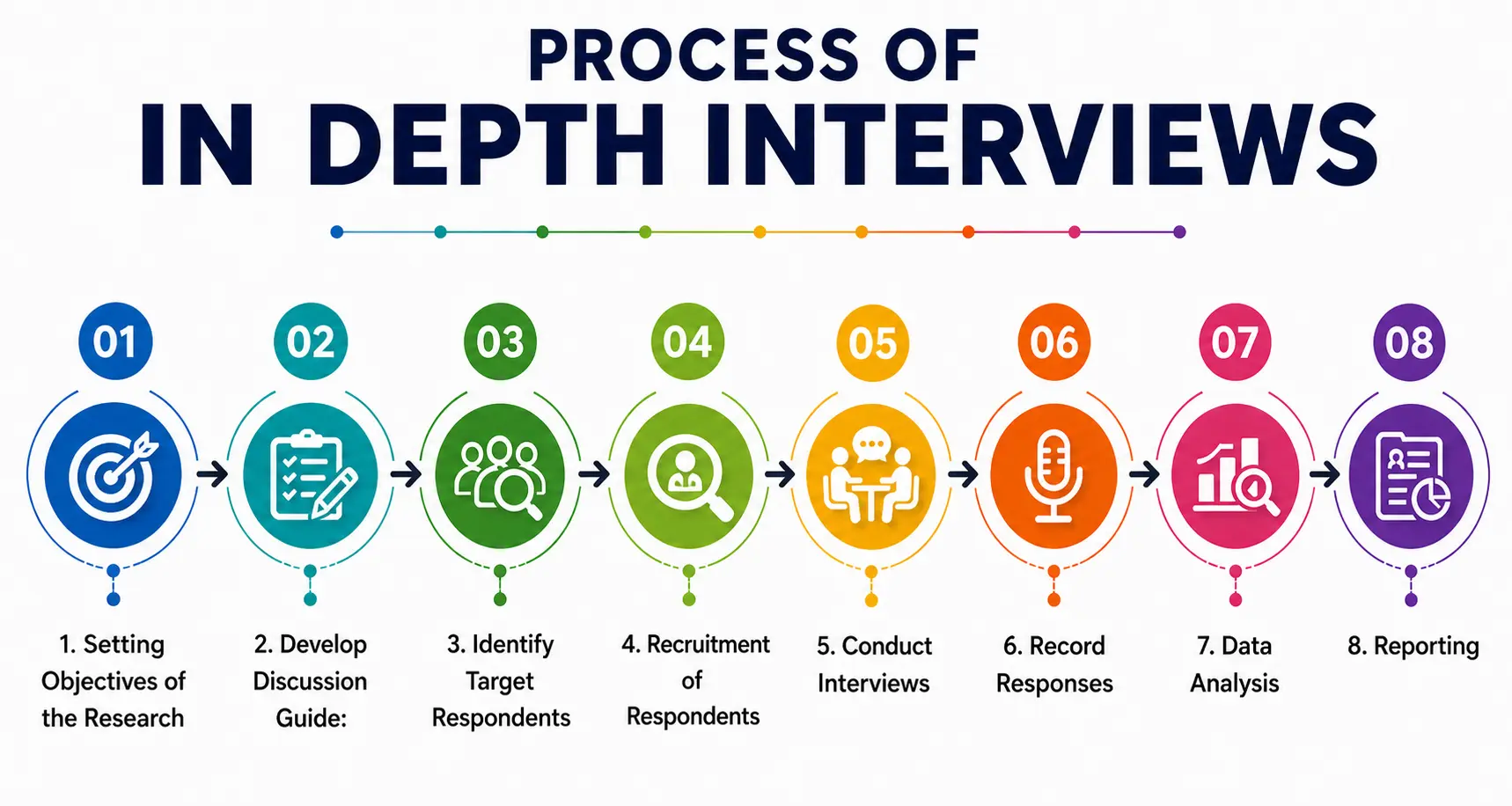
A rigorous process is crucial in ensuring that IDI research yields productive results in terms of information obtained, reliability, and applicability of findings. Although flexible in implementation, the success of the IDI is heavily dependent on how systematic the execution of each step in the process is. Below is an actual step-by-step description of how effective IDI research is done:
- Setting Objectives of the Research: Businesses need to clearly know what they seek to accomplish through interviewing their customers. The objective can be exploring consumer motives, analyzing consumer attitudes towards the products being sold, or finding reasons why certain barriers exist, among others. Having the right objectives enables the researchers to tailor the interviews to address the business challenge at hand.
- Develop Discussion Guide: The strategy here involves not a questionnaire that is to be followed without any changes but an interview guideline. This involves providing information on the main topic and giving interview moderators the ability to adjust the conversation depending on the answers of respondents. The proper development of the discussion guide is essential to maintain uniformity throughout the interview process and allow room for discussion.
- Identify Target Respondents: The selection of the appropriate group of respondents is vital when it comes to applying this type of qualitative strategy. As the method in question requires depth rather than quantity, it is important to choose respondents who will have experiences and/or behaviors matching the aim of research. The choice of suitable people can be critical when discussing the results obtained.
- Recruitment of Respondents: Recruitment should be structured and targeted, using databases, field sourcing, or referrals. Proper screening, clear communication, and efficient scheduling help ensure relevant participation and better-quality insights. It is also important to offer a fair incentive, such as a gift or monetary honorarium, to respect respondents’ time and encourage genuine participation.
- Conduct Interviews: This is the essence of IDI research methodology, where information is collected from real-world interactions. Interviewing is done in a more structured manner than a simple dialogue exchange, which makes respondents more comfortable while expressing their experiences and views. The interviewer’s job is not only to pose questions but also to steer the conversation towards valuable information.
- Record Responses: After the interview, responses have to be documented in a manner suitable for future analysis. This may have audio recording, transcription, and even detailed note-taking. Recording responses is essential in qualitative research as insights are usually obtained from subtle body language, stories, and context. Careful documentation will ensure that useful information is captured, ready for systematic analysis
- Data Analysis: In analysis, discussions are translated into strategic information. The task here for the researcher involves reviewing answers to detect common patterns, recurrent themes, emotional triggers, and significant differences among respondents. The reason behind the analysis is to go beyond the answer level and gain deeper insights that can help make better strategic decisions.
- Reporting: Reporting is the last stage of IDI. Good reporting should go beyond providing a simple account of interviews conducted. Instead, findings from interviews should be presented under certain categories with relevant interpretations and suggestions. The main aim of doing so is to ensure that insights gained from IDIs influence decisions made.
Advantages of In-Depth Interviews
The benefits of the IDIs in India include the following:
- Deep Insights: One of the biggest strengths of the IDI research method is its ability to uncover motivations, emotions, perceptions, and thought processes that are often missed in structured research formats. Through detailed one-on-one conversations, respondents are able to explain not just what they think, but why they think that way. This helps businesses understand hidden barriers, emotional drivers, personal experiences, and behavioral triggers. Such depth is especially valuable when exploring complex topics like consumer choice, brand trust, lifestyle decisions, or social behavior.
- Flexibility: Whether the goal is to understand rural consumers, urban professionals, industry experts, or policy stakeholders, IDIs can be customized accordingly. The nature of the method allows interviewers to adjust the flow of the conversation based on responses, making it easier to explore valuable insights. This flexibility makes IDI research effective across all diverse contexts.
- Rich Data: Unlike closed-ended surveys that generate fixed responses, IDI research produces rich qualitative data. Each interview reveals stories, experiences, beliefs, and nuanced perspectives that provide a deeper understanding of the subject. This often helps businesses identify patterns or opportunities that may not emerge through quantitative data alone. The quality of information gathered is often more detailed and strategically valuable.
- Better Decision-Making: By uncovering real motivations and market realities, businesses can reduce assumptions and improve strategic clarity. This strengthens decisions related to product development, market entry, communication strategy, customer experience, or brand positioning. Organizations gain insights using actual human behavior rather than simply relying on broad data trends.
- Human-Centric Understanding: This approach captures real experiences, personal narratives, and realities that shape decisions. This human-centric approach is particularly valuable in today’s market, where understanding consumer life, not just consumer response, can create a competitive advantage. By focusing on lived experiences rather than baseless answers, businesses can develop strategies that are more relevant and effective.
Challenges of Conducting IDIs in India
While the IDI research method is highly effective, conducting the IDI research method in India comes with unique challenges due to the country’s diversity, scale, and complexity. India’s varied languages, cultures, and regional differences mean that executing idis in India requires far more than a standardized approach. The common challenges experienced are:
- Language Diversity: India’s linguistic diversity is one of the biggest challenges in qualitative research. With multiple languages and regional dialects, respondents are often more comfortable expressing themselves in their native language. This means interviews must be localized carefully, not just translated. Without proper language adaptation, important nuances and emotional depth can be lost.
- Cultural Sensitivity: Cultural norms vary significantly across India, influencing how people respond to questions. Social hierarchy, gender roles, local customs, and community values can all affect openness. Moderators need cultural understanding to build trust and navigate conversations appropriately. A culturally unaware approach can impact both respondent comfort and insight quality.
- Respondent Trust: Building trust is essential for successful IDI research. In many cases, respondents may hesitate to share honest opinions, especially on personal, financial, or sensitive topics. Establishing credibility, ensuring confidentiality, and creating a comfortable environment are critical for authentic responses.
- Geographic and Operational Complexity: India’s geographic spread can make field execution challenging. Reaching respondents across metros, small towns, and rural areas often involves logistical hurdles such as travel, accessibility, and local coordination. This makes planning and field management especially important.
- Urban-Rural Differences: Consumer behavior differs significantly between urban and rural India. Urban respondents may be more familiar with interviews and structured discussions, while rural respondents may require more contextualization and trust-building. Using the same moderation style across both segments may reduce effectiveness.
- Moderator Quality: The quality of In-Depth Interviews in India depends heavily on moderator capability. Interviewers must be skilled in probing, neutrality, language adaptation, and cultural understanding. Poor moderation can lead to shallow insights or biased responses.
- Data Interpretation: Analyzing qualitative insights in India can also be complex. Responses are often shaped by regional context, indirect communication, or social norms. Researchers must interpret not just what is said but also what it means within context. This requires strong analytical understanding to avoid oversimplification.
Conclusion
In a world where consumer decisions are shaped by emotion, context, culture, and lived experience, understanding people requires more than broad data trends. In-depth interviews help businesses move beyond assumptions and uncover motivations behind behavior.
In a market as layered and diverse as India, In-Depth Interviews are not just a qualitative tool; they are a critical framework for decoding complexity. Businesses that invest in conversations are often better equipped to understand regional nuance, consumer relevance, and strategic opportunity.