
Key Takeaways
- Market research helps businesses understand customer needs and market demand
- A clear market research process improves decision-making and reduces risk
- Companies use data collection methods to turn information into actionable business insights
- Startups use research to validate ideas before investing money
- Understanding consumer behavior drives long-term business growth
- Working with experienced research firms improves data quality and insights
Introduction
Market research is an essential part of creating products, expanding markets, and formulating marketing strategies that businesses rely on.
Did you know? According to the U.S. Small Business Administration (.gov), one of the most common reasons startups fail is launching products without understanding market demand. Businesses that analyze their target market before launching are far more likely to succeed.
This is the reason why the question “what is market research” is important to any business owner, entrepreneur, startup founder, and business leader. Market research assists companies in understanding the needs of their customers, assessing competitors, and studying market trends prior to making critical choices.
Imagine launching a product without knowing whether customers want it. Sounds risky, right?
Market research removes that uncertainty. Instead of guessing, companies are able to rely on data that is real, as well as customer feedback and insights from the industry to inform their strategies. NitiGlobal Research and Analytics supports companies by gathering and analyzing market data so businesses can make smarter decisions.
In simple terms, market research transforms ideas into data-backed strategies that increase the chances of success.
Table of Contents
What Market Research Means for Businesses Today
Understanding what market research means in business is the first step toward making informed decisions.
Market research is the structured process of gathering and analyzing information about:
- Customers
- Competitors
- Industry trends
- Market demand
- Buying behavior
Businesses use this information to develop strategies that align with real customer needs.

Key Elements of Market Research
- Customer insights
- Competitive analysis
- Industry trends
- Data collection methods
- Actionable business insights
Harvard Business School notes that companies that rely on data-driven decisions are significantly more likely to outperform competitors.
Why Businesses Need Market Research Before Making Decisions
Before launching a product or expanding into a new market, businesses must understand the environment in which they operate.
Market research helps companies answer critical questions such as:
- Who are our customers?
- What problem are they trying to solve?
- What price are customers willing to pay?
- What competitors already exist?
Major Business Problems Market Research Solves
- Product inability due to a lack of sales
- Incorrect pricing strategy
- Poor target audience identification
- Ineffective marketing campaigns
Expert in marketing Philip Kotler once said:
“The best advertising can be done by happy customers.”
But to satisfy customers, businesses must first understand them.
How Market Research Works in Real Business Situations
Many people ask: how market research works in real business environments.
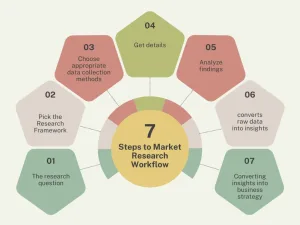
In order to convert raw data into a business strategy, a logic-based framework is used.
Step-by-Step Market Research Workflow
- The research question
- Pick the Research Framework
- Choose appropriate data collection methods
- Get details
- Analyze findings
- Converting insights into business strategy
Example
Imagine a company preparing to introduce a new drink for fitness.
Market research might reveal:
- Customers prefer low-sugar beverages
- Younger consumers prefer eco-friendly packaging
- Price sensitivity can be found in some markets
These knowledge-based insights affect the design, pricing, and marketing.
Market Research Process Explained Step-by-Step
The market research process follows a structured research framework.
Step 1: Define the Research Objective
Businesses must first determine what they want to learn.
Examples include:
- Customer preferences
- Market demand
- Competitor strategies
Step 2: Develop the Research Plan
This stage involves selecting research tools and defining the sample audience.
Step 3: Conduct Data Collection
Researchers gather information using surveys, interviews, and analytics tools.
Step 4: Analyze Market Data
Analysts identify patterns and trends in customer behavior.
Step 5: Create Actionable Business Insights
The final step converts raw data into insights that guide strategy.
Table: Market Research Framework
| Step | Purpose | Example |
|---|---|---|
| Problem Definition | Identify business challenge | Declining sales |
| Research Design | Select a research method | Survey or interviews |
| Data Collection | Gather customer insights | Online survey |
| Data Analysis | Identify trends | Customer preferences |
| Strategy Development | Guide decisions | Product redesign |
Types of Market Research Businesses Use
Knowing different types of study aids, companies select the most appropriate method.
Primary Market Research
Primary research collects original data directly from customers. Examples:
- Customer surveys
- Interviews
- Focus groups
- IDI
Secondary Market Research
Secondary research analyzes existing data sources. Examples:
- Government reports
- Industry publications
- Market statistics
Qualitative Research
Qualitative research studies opinions and motivations.
Quantitative Research
Quantitative research measures numerical data and trends.
Data Collection Methods Used in Market Research
Companies use different data collection methods depending on the research objective.
Surveys
Surveys help collect feedback from large audiences quickly.
Interviews
Interviews provide deeper insights into customer experiences.
Focus Groups
Focus groups gather detailed feedback from small groups.
Digital Analytics
Online analytics tools help businesses analyze customer behavior on websites and apps.
Benefits of Market Research for Businesses
The benefits of market research extend across every stage of business growth.
Key Benefits
- Improved product development
- Better marketing strategy
- Reduced business risk
- Improved customer satisfaction
According to Statista, companies that use market insights are more likely to identify new opportunities before competitors.
What Market Research Can Do for Startups
Starting a business can be both thrilling and concerning due to the amount of risk involved. Many entrepreneurs begin their journey with a developed idea, but the market often does not respond as predicted. This is where market research becomes increasingly important, as the business model may need to be rewritten. Studying rivals, prospective buyers, and demand before the business attempt reduces risk and allows for better decision-making.
Market research allows startups to test their ideas, understand their audience, and design strategies based on real insights rather than assumptions. Startups that prioritize research undoubtedly achieve greater market clarity as they avoid the mistakes that are often made at the start of a business.

Idea Validation Through Market Research
Market research and idea validation go hand in hand. Research is used to gather feedback from potential users to confirm the demand for the product prior to development.
Surveys, interviews, or prototype testing, focus groups, etc. These methods help answer important questions such as:
- Does this product solve a real problem?
- Would customers be willing to pay for it?
- How does it compare with existing solutions?
Researching these questions gives a startup confidence in its product because it proves its idea is a good fit for the market.
Identifying the Right Target Customers
One of the best things market research can do is find the right customers. New businesses are often trying to sell to everyone, but most are successful when they focus on a specific group of customers.
Market research allows startups to look at variables such as:
- Age and demographics
- Lifestyle and interests
- Purchasing behavior
- Customer pain points
A startup can better serve its audience by focusing its marketing and product campaigns here.
Developing a Smart Pricing Strategy
Pricing plays a major role in whether a startup succeeds or struggles. If the price is too high, customers may look for alternatives. If it is too low, the business may not generate enough revenue.
Market research helps startups determine pricing strategies by analyzing:
- Competitor pricing models
- Customer willingness to pay
- Market demand levels
- Product value perception
Through research, startups can establish pricing that balances profitability with customer expectations.
Real Startup Example
Consider a food delivery startup preparing to enter a crowded market. Before launching its service, the company conducted surveys and interviews with potential customers. The founders initially believed that customers cared most about lower delivery fees.
However, the research revealed a different insight. Customers prioritized speed and reliability over discounts. People preferred faster delivery times even if the price was slightly higher.
Based on this finding, the startup focused on improving logistics and delivery efficiency instead of offering heavy discounts. This strategy helped the company stand out in the market and attract loyal customers.
This example highlights how market research transforms assumptions into actionable business decisions.
What drives growth is an understanding of consumer behavior
Businesses do not succeed simply by offering products. They succeed by understanding why customers choose those products in the first place. This is where consumer behavior research becomes a powerful tool.
Consumer behavior studies the psychological, cultural, and social factors that influence purchasing decisions. When businesses understand these factors, they can design better products, create stronger marketing messages, and build long-term relationships with customers.
Organizations that invest in consumer behavior research gain insights that help them stay ahead of competitors.

Key Factors That Influence Consumer Behavior
Several elements shape how customers evaluate products and make buying decisions.
Emotional Triggers
Many purchasing decisions are influenced by emotions rather than logic. Customers may choose products that make them feel confident, safe, or satisfied.
For example, a skincare brand may focus on emotional messaging about self-care and confidence rather than just product ingredients.
Cultural Influences
Cultural values and social environments often shape consumer preferences. Products that appeal to one group may not resonate with another due to differences in lifestyle, traditions, or expectations.
Understanding cultural influences helps businesses adapt their products and marketing strategies to different markets.
Buying Habits
Customers often follow predictable buying patterns. Some people research extensively before purchasing, while others make quick decisions based on brand familiarity.
Market research helps companies analyze these habits so they can design smoother purchasing experiences.
Brand Trust
Trust plays a major role in customer decisions. Consumers are more likely to purchase from brands they recognize and believe in.
Businesses that build credibility through quality products and transparent communication often gain stronger customer loyalty.
According to Harvard Business Review, companies that prioritize customer insights and consumer understanding consistently outperform competitors in terms of revenue growth and customer retention.
When businesses truly understand their customers, they can develop strategies that meet real needs rather than relying on guesswork.
What to Look for When Choosing a Market Research Company
Many businesses decide to work with professional research firms to gain deeper insights into their market. Choosing the right research partner is important because the quality of research directly affects the quality of business decisions.
A reliable market research firm helps companies gather accurate information, interpret market trends, and convert data into meaningful strategies.
Key Factors to Consider When Selecting a Research Partner
Research Experience
Experience is one of the most important factors when choosing a research firm. Firms with years of industry experience understand how to design effective studies and interpret complex data.
Experienced researchers also know how to identify the right questions to ask customers, which improves the quality of insights gathered.
Industry Knowledge
Different industries have different market dynamics. A research firm with knowledge of your specific industry will better understand customer behavior, competition, and market trends.
Industry expertise allows researchers to provide more relevant and actionable insights.
Data Accuracy and Reliability
Reliable data is essential for making informed decisions. Businesses should choose research partners that follow strict data collection and analysis standards.
Accurate research helps businesses avoid costly mistakes and ensures that strategies are based on trustworthy information.
Research Methodology
A professional research firm should use structured methodologies that combine both qualitative and quantitative research techniques.
These methods may include:
- Consumer surveys
- In-depth interviews
- Focus groups
- Market trend analysis
- Digital analytics
Combining multiple research approaches allows firms to gather both statistical data and deeper customer insights.
NitiGlobal Research and Analytics assists businesses by conducting structured research and translating complex market data into strategic recommendations. By using systematic research frameworks, they help companies better understand their customers and industry trends.
Working with experienced research partners ensures that businesses receive accurate, actionable insights that guide smarter decisions.
Real-Life Case Study: How Market Research Changed a Product Launch
A beverage company planned to launch a high-energy sports drink.
Initial assumptions suggested customers wanted strong flavors and high caffeine levels.
However, market research revealed:
- Consumers preferred natural ingredients
- Many avoided high caffeine content
- Eco-friendly packaging influenced purchasing decisions
The company redesigned the product based on these insights and achieved strong sales during its first year.
This example demonstrates how market research prevents costly mistakes.
Turning Market Insights Into Winning Business Strategy
Market research alone does not create success. Businesses must use insights effectively.
Companies convert insights into strategy by:
-
- improving product features
- refining marketing campaigns
- identifying new market opportunities
- adjusting pricing strategies
Businesses that continuously monitor market trends stay ahead of competitors.
The Smart Business Advantage: Why Market Research Leads to Long-Term Success
Successful companies use market research to understand their audience, determine the right timing for a product, and create a product that consumers truly want. The right research will reduce risks for the company as well as its consumers, and assure the success of the company in the long run.
Market research lays the foundation for a successful company. Divining research leads to lower success probabilities. Guessing for greater risks and lower success probabilities.
NitiGlobal Research and Analytics provides companies with professional research services that analyze raw data and provide actionable insights.
When companies listen to their market and act on real data, they position themselves for sustainable growth and stronger customer relationships.